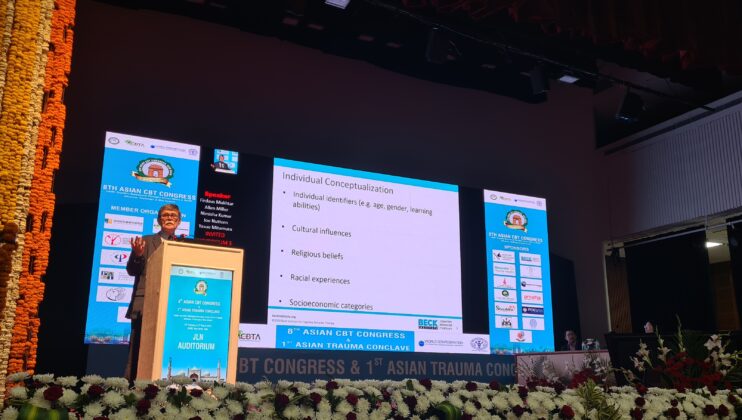
Supporting the Growth of CBT in Asia: Reflections on the 8th Asian CBT Conference
April 10, 2024/Sarah Fleming
Beck Institute was proud to play a pivotal role in the 8th Asian CBT Conference which was held in New Delhi, India from February 28 to March 2, 2024.
April 2, 2024/Sarah Fleming
Dr. Judith Beck is pleased to announce that Dr. Allen Miller has been appointed acting Executive Director. Dr. Miller has been with Beck Institute since 2018.
March 5, 2024/Sarah Fleming
We spoke with Rob Rosa from Philadelphia nonprofit New Leash on Life about how the organization helps justice-impacted individuals build resilience using principles from both CBT and CT-R in their animal-assisted therapy approach.
February 16, 2024/Sarah Fleming
A common misconception about CBT is that it is outdated and even harmful for the treatment of trauma. But research shows just the opposite.
January 31, 2024/Sarah Fleming
When clients get caught up in unhelpful thinking cycles, mindfulness can help them refocus their attention so they can focus on their values.
January 16, 2024/Sarah Fleming
When violent conflict erupts, it is natural for the public to react strongly. People who bear witness feel a range of emotions, including anger, sorrow, disgust, horror, fear, and grief.
January 4, 2024/Sarah Fleming
Happy New Year from Dr. Judith Beck and Beck Institute! Here are some of the exciting things we have planned for 2024.
December 19, 2023/Sarah Fleming
Jenna DiLossi, PsyD, ABPP, explores the role that perfectionism plays in the development, maintenance, and treatment of eating disorders.
December 5, 2023/Sarah Fleming
Beck Institute hosted a live virtual workshop for experienced CBT practitioners who wanted to improve their supervisory skills.
November 17, 2023/Sarah Fleming
Dr. Judith Beck shares three pieces of advice for clinicians and students who are just getting started learning CBT.
November 2, 2023/Sarah Fleming
In this case study, Beck Institute clinician Francine Broder, PsyD, describes a client’s presenting problems, as well as his strengths, and some of the ways that she used a recovery-oriented approach to CBT treatment to accommodate his individual needs and goals.
October 23, 2023/Sarah Fleming
Participants in a Beck Institute CBT supervision group from Malaysia reflected on the experience of learning from and with their peers.
October 10, 2023/Sarah Fleming
PRESS RELEASE - FOR IMMEDIATE RELEASE OCTOBER 10, 2023 BALA CYNWYD, PA – Beck Institute for Cognitive Behavior Therapy […]
October 2, 2023/Sarah Fleming
Indecision can be defined as the inability or hesitancy to make a decision quickly, or experiencing difficulty making decisions. Indecision can become problematic when it causes an individual emotional distress or leads to negative consequences.
August 31, 2023/Sarah Fleming
Although effective treatments have been developed for many mental health disorders, most people do not receive these life-changing evidence-based therapies.
August 4, 2023/Sarah Fleming
Each year on July 18th, individuals do one thing to improve mental health in their communities, honoring Dr. Beck with a day of action.
July 26, 2023/Sarah Fleming
Dr. Norman Cotterell shares a useful metaphor that can help clients live fully in the present.
June 27, 2023/Sarah Fleming
Leading expert in culturally responsive CBT, Pamela A. Hays, PhD, talks to Beck Institute about the steps clinicians should take to ensure they are appropriately adapting CBT for clients from a range of backgrounds and cultures, and personal preferences, characteristics, and needs.
June 26, 2023/Sarah Fleming
Beck Institute’s leadership recently traveled to Japan, Jordan, and Korea to help disseminate CBT and learn more about CBT training needs internationally.
June 14, 2023/Sarah Fleming
Affirmative Cognitive Behavior Therapy can help sexual and gender minority clients increase self-compassion and decrease negative self-talk and beliefs.